
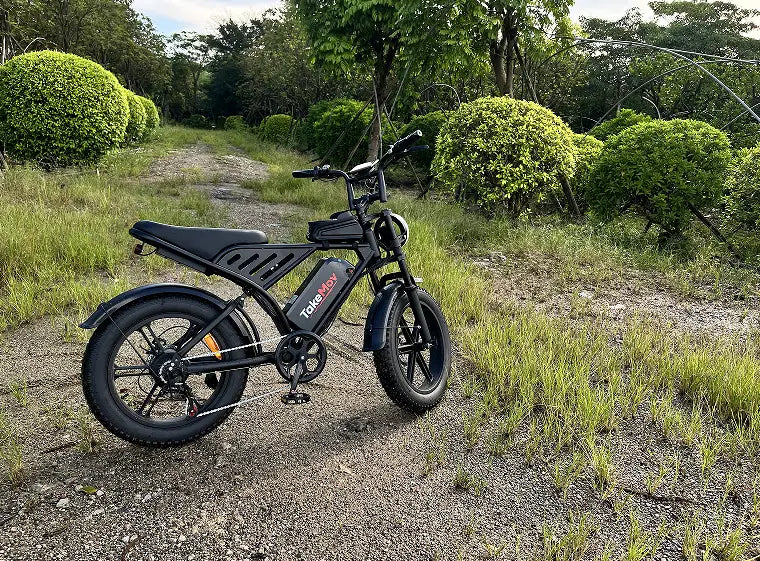
Finding the right moped-style eBike as a heavier rider is not just about choosing the bike with the biggest motor or highest payload rating.
Riders weighing 250–350+ lbs need to consider how a bike actually performs in real-world conditions, including acceleration, hill climbing, braking confidence, battery range, and long-term comfort.
This guide compares the best moped-style eBikes for heavy riders and helps you choose the right model based on your weight, riding style, terrain, and daily mileage.
Quick Decision: Which Heavy Rider eBike Should You Choose?
| Your Situation | Best Choice | Why |
|---|---|---|
| 250–300 lbs daily commuting | Takemov G35M | Best balance of power, comfort, and price |
| 300–350+ lbs riders | Takemov G35H | More battery reserve and stronger long-distance performance |
| Mostly flat city riding | Takemov G35 | Enough power without overspending |
| Frequent hills | Ariel Rider X-Class 60V / G35H | Higher torque helps maintain speed |
| Mixed terrain | Goat Power V3 | Better off-road comfort |
| Want premium ownership | Ride1Up Revv 1 DRT | Refined urban riding experience |
Best Moped Style eBikes for Heavy Riders 2026
Choosing the right moped-style eBike isn't about finding the highest top speed or the biggest motor. For heavier riders, comfort, braking confidence, battery capacity, and overall ride quality usually matter much more over months of ownership.
The bikes below stand out because they each excel in different riding situations, whether you're commuting through the city, climbing steep hills, or taking longer weekend rides.
Quick Comparison
| Bike | Best For | Payload | Battery | Suspension |
|---|---|---|---|---|
| Takemov G35M | Best Overall | High | 48V 25Ah | Full Suspension |
| Takemov G35H | Best Long Range | High | Dual 48V 50Ah | Full Suspension |
| Ride1Up Revv 1 DRT | Best for City Riding | High | Large | Full Suspension |
| Goat Power V3 | Best Off-Road | High | Large | Full Suspension |
| Ariel Rider X-Class 60V | Best Hill Climbing | High | Large | Full Suspension |
| Super73 RX | Best Style & Community | Moderate | Medium | Front & Rear Suspension |
Best Overall for Most Heavy Riders - Takemov G35M

For riders weighing between roughly 250 and 320 pounds, the Takemov G35M offers one of the most balanced combinations of power, comfort, battery capacity, and value.
Rather than chasing the highest speed figures, it focuses on the characteristics that heavier riders appreciate most: strong low-speed torque, predictable handling, hydraulic brakes, and a battery large enough for practical everyday riding.
Why It Fits Heavy Riders
-
Excellent balance of power and price
-
Approximately 80 Nm torque for confident acceleration
-
48V 25Ah battery for longer real-world range
-
Comfortable upright riding position
-
Full suspension improves ride quality
Best For
Daily commuting, weekend rides, and riders looking for the best overall value.
Best Long-Range Moped Style eBike - Takemov G35H
If your rides regularly exceed 40–50 miles or include steep hills, the G35H is the strongest option in the lineup.
Its dual-battery system provides substantially more usable range, while maintaining stronger performance throughout longer rides instead of feeling weaker as battery levels decrease.
Why It Fits Heavy Riders
-
Dual 48V 50Ah battery
-
Outstanding long-distance capability
-
Strong acceleration even with heavier riders
-
Excellent choice for riders over 300 lbs
Best For
Long-distance riders, larger riders, and anyone who wants maximum range.
Best Premium City Riding Experience - Ride1Up Revv 1 DRT
The Ride1Up Revv 1 DRT isn't built around extreme specifications. Instead, it delivers a polished urban riding experience with quality components and balanced handling.
Many heavier riders appreciate its refined suspension, comfortable riding position, and excellent build quality.
Why It Fits Heavy Riders
-
Smooth handling
-
Premium fit and finish
-
Comfortable geometry
-
Excellent everyday usability
Best For
Urban commuting and riders who prioritize refinement over outright performance.
Best for Mixed Terrain - Goat Power V3
If your riding regularly includes gravel roads, dirt paths, or uneven pavement, the Goat Power V3 is one of the strongest choices.
Its fat tires and full suspension create a planted, confidence-inspiring ride across a variety of surfaces.
Why It Fits Heavy Riders
-
Excellent off-road capability
-
Stable fat-tire platform
-
Comfortable suspension
-
Strong climbing performance
Best For
Weekend adventures, gravel riding, and mixed-terrain routes.
Best for Hill Climbing - Ariel Rider X-Class 60V
For riders living in mountainous areas, torque matters more than top speed.
The X-Class remains one of the strongest hill-climbing moped-style eBikes thanks to its powerful drivetrain and responsive acceleration.
Why It Fits Heavy Riders
-
Strong torque
-
Excellent climbing ability
-
Large battery
-
Confident throttle response
Best For
Steep terrain and riders who frequently tackle hills.
Best for Style and Urban Cruising - Super73 RX
The Super73 RX continues to be one of the most recognizable names in the moped-style eBike market.
While it doesn't dominate specification sheets, it offers an enjoyable riding experience backed by a large owner community and iconic styling.
Why It Fits Heavy Riders
-
Distinctive appearance
-
Comfortable riding position
-
Strong brand community
-
Easy urban cruising
Best For
City riding, beach cruising, and riders who value style as much as performance.
At a Glance: Which Bike Fits You Best?
| If You... | Recommended Bike |
|---|---|
| Want the best overall balance | Takemov G35M |
| Need maximum riding range | Takemov G35H |
| Mainly ride in the city | Ride1Up Revv 1 DRT |
| Ride gravel and trails | Goat Power V3 |
| Frequently climb steep hills | Ariel Rider X-Class 60V |
| Care most about style | Super73 RX |
No single bike is perfect for every rider. The best choice depends on your weight, riding style, terrain, and daily mileage. Rather than comparing only motor wattage or top speed, focus on how each bike performs as a complete system—including braking, suspension, battery capacity, and overall ride comfort.
The 4 Specifications That Matter Most for Heavy Riders
If you're shopping for a moped-style eBike, you'll probably compare motor power, battery size, top speed, and payload capacity.
Those are all useful numbers—but for riders weighing 250 to 350+ pounds, they don't tell the whole story.
A bike that looks impressive on paper may still feel sluggish under load, while another with similar specifications can feel noticeably stronger, smoother, and more confidence-inspiring.
After comparing dozens of moped-style models and reviewing feedback from heavier riders, four factors consistently have the biggest impact on the overall riding experience.
1. Payload Capacity Is Only the Starting Point
One of the first specifications many heavier riders look for is payload capacity.
That's understandable—but it's also one of the most misunderstood specifications in the eBike industry.
A payload rating simply tells you the maximum weight the manufacturer says the bike can safely support, including:
-
Rider
-
Cargo
-
Accessories
-
Anything mounted to the bike
It does not measure:
-
Acceleration
-
Climbing ability
-
Braking performance
-
Ride quality
-
Battery efficiency
For example, imagine two bikes that both advertise a 400-pound payload capacity.
On paper, they appear equally capable.
In reality, one may feel responsive and stable with a 300-pound rider, while the other struggles on hills or feels less composed at higher speeds.
That's because payload ratings don't account for how the motor, battery, frame, brakes, and suspension work together under load.
Think Beyond the Number
Instead of asking:
"Can this bike carry me?"
Ask:
"How well does this bike ride with my weight?"
That shift in thinking usually leads to a much better buying decision.
What to Look For
Rather than focusing on payload capacity alone, consider the bike as a complete package.
| Specification | Why It Matters More Than Payload Alone |
|---|---|
| Motor Torque | Determines how easily the bike accelerates and climbs hills |
| Battery Capacity | Helps maintain practical riding range under heavier loads |
| Hydraulic Brakes | Provide stronger, more consistent stopping power |
| Frame & Suspension | Improve stability and reduce flex over rough roads |
A strong payload rating is still important—but it should be viewed as the minimum requirement, not the deciding factor.
2. Torque Matters More Than Motor Wattage
Motor wattage gets most of the attention in eBike marketing.
In practice, heavier riders often notice torque long before they notice peak wattage.
Torque is what you feel when:
-
Pulling away from a traffic light
-
Starting on an incline
-
Passing slower riders
-
Carrying extra cargo
-
Riding into strong headwinds
A bike with higher torque generally feels more effortless because it produces stronger low-speed acceleration.
That's especially valuable when your total riding weight—including the bike itself—approaches or exceeds 350 pounds.
Why Wattage Doesn't Tell the Whole Story
Many riders assume that a higher wattage motor automatically performs better.
Unfortunately, it's not that simple.
Two bikes may both advertise a 750W motor, yet deliver very different riding experiences depending on:
-
Motor tuning
-
Controller output
-
Battery voltage
-
Torque characteristics
-
Overall drivetrain efficiency
That's one reason experienced riders often ask about torque before asking about wattage.
Recommended Torque for Heavier Riders
While every rider's needs are different, the following ranges work well as a practical buying guideline.
| Rider Weight | Recommended Torque |
|---|---|
| Under 220 lb | 50–60 Nm |
| 220–280 lb | 60–70 Nm |
| 280–330 lb | 70–90 Nm |
| 330 lb+ | 80 Nm or higher preferred |
These aren't strict rules, but they provide a good starting point when comparing bikes.
For example, the Takemov G35M and G35H produce approximately 80 Nm of torque, giving heavier riders noticeably stronger acceleration than many entry-level commuter eBikes with lower torque outputs.
As one experienced rider put it:
"At 300 pounds, the difference between 60 Nm and 80 Nm isn't something you notice on a spec sheet—it's something you feel the moment the light turns green."
That simple observation captures what numbers alone often can't.
3. Bigger Batteries Aren't About Riding Farther—They're About Maintaining Range
Manufacturers often advertise impressive maximum ranges.
Some claim:
-
70 miles
-
90 miles
-
Even 120 miles
Those figures aren't necessarily inaccurate—but they're usually measured under ideal conditions.
Typical test conditions often include:
-
Lighter riders
-
Lower speeds
-
Minimal wind
-
Flat terrain
-
Moderate pedal assist
Real-world riding is different.
For heavier riders, battery capacity becomes less about setting distance records and more about maintaining a practical range without constant charging.
Why Rider Weight Affects Battery Consumption
Every time the bike accelerates, climbs a hill, or fights wind resistance, the motor draws energy from the battery.
A heavier combined weight means:
-
Higher power demand
-
More frequent peak current
-
Faster battery consumption
That's simply physics.
Estimated Real-World Range for a 300 lb Rider
The following estimates assume:
-
Combined rider weight around 300 pounds
-
Moderate pedal assist
-
Mixed city riding
-
Speeds between 20–25 mph
-
Relatively flat terrain
| Battery Size | Estimated Real-World Range |
|---|---|
| 48V 15Ah (720Wh) | 25–35 miles |
| 48V 25Ah (1200Wh) | 40–60 miles |
| Dual 48V 50Ah (2400Wh) | 70–90 miles |
These aren't laboratory numbers.
They're practical expectations that many riders find much closer to everyday riding conditions.
That's also why many heavier riders prefer larger batteries—not necessarily because they ride farther every day, but because they enjoy having extra capacity without worrying about every mile.
4. Brakes, Tires, and Frame Stability Matter More Than an Extra 5 MPH
It's easy to compare top speeds.
It's much harder to compare how a bike feels when slowing down from those speeds.
For heavier riders, braking performance often becomes one of the most important safety considerations.
More weight creates more momentum.
More momentum requires more stopping force.
Hydraulic Brakes Are Worth Prioritizing
Compared with mechanical disc brakes, hydraulic systems generally provide:
-
Better braking modulation
-
More consistent stopping performance
-
Less hand fatigue
-
Improved control on long descents
If you're regularly riding above 25 mph—or carrying additional cargo—hydraulic brakes become even more valuable.
Larger brake rotors can also improve heat management during repeated braking.
Fat Tires Improve More Than Comfort
Many riders choose fat tires because they like the look.
Heavier riders often appreciate them for another reason.
A wider contact patch can help improve:
-
Stability
-
Traction
-
Shock absorption
-
Rider confidence on rough pavement
While tire pressure should always follow the manufacturer's recommendations, heavier riders often find that maintaining proper pressure is just as important as choosing the tire itself.
Underinflated tires can increase rolling resistance and reduce battery efficiency, while overinflated tires may sacrifice comfort and grip.
Frame Design Makes a Bigger Difference Than Many Riders Expect
The frame is the foundation of the entire riding experience.
A rigid, well-designed frame helps the bike feel predictable at higher speeds and reduces unwanted flex when accelerating, cornering, or riding over uneven pavement.
Combined with quality suspension and a longer moped-style seat, it can make longer rides feel significantly less tiring.
These are details that rarely appear in marketing headlines—but they often determine whether riders still enjoy the bike after months of ownership.
Quick Checklist Before You Buy
Before choosing any moped-style eBike, ask yourself these questions:
Is the payload rating comfortably above my total riding weight?
Does the bike provide enough torque for my local terrain?
Is the battery large enough for my realistic riding distance?
Does it include hydraulic disc brakes?
Is the frame designed for stability rather than just appearance?
If the answer to most of these questions is yes, you're much more likely to end up with a bike that feels capable not just on paper, but in everyday riding.
Heavy Rider Range Calculator
| Rider Weight | Estimated Range Reduction |
|---|---|
| 180 lb | Baseline |
| 220 lb | -5% to -10% |
| 260 lb | -10% to -15% |
| 300 lb | -15% to -25% |
| 350 lb | -20% to -30% |
Why the Takemov G35 Series Fits Heavy Riders Better Than Most Entry-Level Moped eBikes
By now, we've covered the four things that matter most for heavier riders:
-
Real-world performance—not just payload capacity
-
Strong, usable torque
-
Practical battery capacity
-
Confident braking and ride stability
The next question is simple:
Which bike actually delivers those qualities without jumping into motorcycle-level pricing?
For many riders, that's where the Takemov G35 Series deserves a closer look.
Rather than trying to be the fastest or the most expensive moped-style eBike on the market, the G35 lineup focuses on the characteristics that heavier riders tend to appreciate most—predictable power delivery, comfortable ergonomics, generous battery capacity, and everyday practicality.
Instead of offering one "one-size-fits-all" model, Takemov builds the G35 Series in three versions, allowing riders to choose based on their weight, riding terrain, and daily mileage.
Which G35 Model Is Right for You?
Although the three bikes share the same overall moped-style platform, they're designed for different types of riders.
| Model | Best For | Top Speed* | Battery | Recommended Rider |
|---|---|---|---|---|
| Takemov G35 | Daily commuting & recreational riding | Up to 33 mph | 48V 15Ah | Up to ~250 lb |
| Takemov G35M | Most heavy riders | Up to 40 mph | 48V 25Ah | 250–320 lb |
| Takemov G35H | Hills, long rides & maximum range | Up to 50 mph (unlocked) | Dual 48V 50Ah | 300–350+ lb |
*Top speeds may vary depending on rider weight, terrain, local regulations, and riding mode.
Looking at the specifications alone, the differences may seem straightforward.
On the road, however, each model serves a noticeably different purpose.
Takemov G35 — A Practical Choice for Everyday Riders
For riders under approximately 250 pounds who primarily commute on relatively flat roads, the standard G35 provides a balanced combination of affordability and capability.
Its 750W motor, paired with a 48V 15Ah battery, delivers enough performance for everyday commuting, weekend rides, and recreational use without carrying unnecessary battery weight or cost.
For lighter riders, this configuration is often sufficient.
However, once rider weight approaches or exceeds 280–300 pounds, you'll likely notice the limitations that naturally come with a smaller battery and lower torque output—especially on hills or during repeated acceleration in city traffic.
That's not a weakness unique to the G35; it's true of most entry-level moped-style eBikes in this category.
Takemov G35M — The Sweet Spot for Most Heavy Riders
For riders between roughly 250 and 320 pounds, the G35M strikes what is arguably the best balance in the lineup.
It increases battery capacity to 48V 25Ah (1,200Wh) while delivering approximately 80 Nm of torque, giving the bike noticeably stronger low-speed acceleration than many entry-level commuter models.
That extra torque isn't just about faster launches.
It helps in situations heavier riders experience every day:
-
Pulling away smoothly from intersections
-
Maintaining momentum on moderate hills
-
Carrying a backpack or groceries without feeling sluggish
-
Riding into headwinds with less effort
The larger battery also provides a valuable buffer against the increased energy consumption that naturally comes with carrying more total weight.
Instead of constantly watching the battery percentage, riders can focus on enjoying the ride.
For many people, that's a bigger quality-of-life improvement than an additional few miles per hour of top speed.
Takemov G35H — Built for Riders Who Ask More From Their Bike
Some riders simply place greater demands on their eBike.
Maybe your commute includes long climbs.
Maybe you regularly ride 40 or 50 miles in a day.
Or perhaps you weigh over 300 pounds and want a bike that feels relaxed rather than constantly working near its limits.
That's where the G35H comes into its own.
With its dual-battery configuration and extended range, the G35H isn't just designed to go farther—it maintains performance more consistently throughout longer rides.
One benefit that's often overlooked is battery stress.
When a battery is constantly pushed close to empty, voltage naturally drops, and many riders notice reduced performance near the end of a ride.
A larger battery helps reduce that effect, providing a more consistent riding experience from the first mile to the last.
For heavier riders, that consistency can be just as valuable as maximum range itself.
How the G35 Series Performs Where Heavy Riders Notice It Most
Specifications are useful.
But riding experience is what people actually remember.
Here's where the G35 Series stands out in everyday situations.
Starting From a Stop
One of the first things heavier riders notice is how confidently a bike pulls away from traffic lights.
Bikes with modest torque often hesitate for a moment before building speed.
The G35M and G35H feel noticeably more immediate, reducing that sluggish sensation that some heavier riders experience with lower-output commuter eBikes.
Climbing Moderate Hills
No eBike can ignore the laws of physics.
As rider weight increases, climbing performance naturally changes.
However, bikes with stronger torque and larger batteries tend to maintain momentum more effectively instead of slowing dramatically halfway up a hill.
For riders living in cities with rolling terrain, this difference becomes apparent almost every day.
Riding Comfort After an Hour
Power isn't everything.
Comfort often determines whether people continue riding week after week.
The G35 Series combines several features that work together to reduce fatigue over longer rides:
-
Extended moped-style saddle
-
Upright riding position
-
Wide 20 × 4.0-inch fat tires
-
Suspension designed to smooth uneven pavement
None of these features is unique on its own.
Together, they create a riding experience that many heavier riders find easier to enjoy over extended distances.
Estimated Real-World Range for Heavier Riders
Manufacturer range estimates are useful as a reference, but they're rarely based on riders weighing 300 pounds.
The following table provides more realistic expectations for mixed riding conditions.
| Model | Battery | Estimated Range (300 lb Rider)* |
|---|---|---|
| G35 | 48V 15Ah | 25–35 miles |
| G35M | 48V 25Ah | 40–60 miles |
| G35H | Dual 48V 50Ah | 70–90 miles |
*Estimated using moderate pedal assist, mixed city riding, average speeds of 20–25 mph, and relatively flat terrain. Actual range varies based on rider weight, terrain, wind, temperature, tire pressure, and riding style.
Providing realistic estimates instead of ideal laboratory numbers helps set better expectations—and usually leads to happier ownership experiences.
Maintenance Tips for Heavy Riders
Heavier riders naturally place more stress on every part of an eBike.
That doesn't mean you'll experience problems—but it does mean regular maintenance becomes even more important.
A few simple habits can significantly improve both performance and long-term reliability.
Check Tire Pressure Regularly
Tire pressure affects much more than comfort.
It also influences:
-
Battery efficiency
-
Cornering stability
-
Braking performance
-
Tire wear
Many heavier riders prefer running slightly higher pressures than lighter riders, while still staying within the manufacturer's recommended range.
Checking tire pressure every week takes only a minute and can noticeably improve how the bike rides.
Inspect Brake Pads More Frequently
More total weight means your brakes work harder every time you slow down.
If you regularly ride at higher speeds or on hilly roads, brake pads may wear faster than expected.
Watch for signs such as:
-
Reduced braking power
-
Squealing noises
-
Longer stopping distances
Replacing worn pads early is inexpensive and helps protect the brake rotors as well.
Keep Wheels Properly Tensioned
Spokes gradually loosen on any bicycle.
Because heavier riders place greater loads on the wheels, it's worth having spoke tension checked periodically—especially during the first few hundred miles of ownership.
Well-tensioned wheels stay truer, feel more stable, and generally last longer.
Charge the Battery Before It Gets Too Low
Lithium-ion batteries perform best when they aren't repeatedly discharged to nearly empty.
If possible:
-
Recharge after longer rides.
-
Avoid storing the battery completely empty.
-
Store it in a cool, dry location when not in use for extended periods.
These habits can help extend battery life over the long term.
Know Your Local eBike Laws Before You Ride
Higher-speed moped-style eBikes may not be classified the same way as standard Class 1–3 eBikes in every U.S. state.
Before riding on public roads or bike paths, check your local regulations regarding speed limits, throttle use, registration, and where higher-performance eBikes are permitted.
Choosing a compliant riding mode can help you stay within local requirements while still enjoying the bike's full capability where appropriate.
FAQs
Can a 300 lb person ride a moped-style eBike?
Yes, provided the bike's rated payload capacity comfortably exceeds the combined weight of the rider, accessories, and cargo.
More importantly, look beyond the payload rating and evaluate torque, braking performance, battery capacity, and frame stability. These factors have a much greater impact on how the bike feels in everyday riding.
How much torque does a heavier rider need?
There isn't a single number that works for everyone, but riders weighing around 280–350 pounds generally benefit from 70–90 Nm of torque.
Higher torque helps with smoother starts, maintaining speed on hills, and carrying additional weight without making the bike feel strained.
Are fat tires better for heavier riders?
For many people, yes. Wider tires can improve stability, traction, and ride comfort by providing a larger contact patch and better cushioning over rough pavement.
That said, proper tire pressure is just as important as tire width.
Is a bigger battery always worth it?
Not always. If your daily rides are relatively short, a smaller battery may be perfectly adequate.
However, heavier riders often appreciate larger batteries because they help offset the increased energy consumption that naturally comes with carrying more weight.
The result isn't just longer range—it can also mean fewer charging cycles and greater peace of mind.
Are 40–50 mph moped-style eBikes legal everywhere?
No. Laws vary by state and even by city.
Many higher-speed models are intended for private property or locations where local regulations permit their use.
Always check applicable laws before riding on public roads.
A Final Word
Choosing a moped-style eBike as a heavier rider isn't about finding the biggest motor or the highest top speed.
It's about finding a bike that continues to feel stable, comfortable, and predictable every time you ride.
Throughout this guide, we've focused on the factors that genuinely influence the riding experience:
-
Real-world performance rather than marketing specifications
-
Usable torque instead of headline wattage
-
Practical battery capacity instead of optimistic range claims
-
Braking confidence and ride stability
-
Long-term comfort over longer rides
Those considerations matter far more than a single specification on a product page.
For riders looking for a practical combination of power, comfort, and everyday usability, the Takemov G35 Series offers a well-balanced range of options.
Rather than asking every rider to buy the same bike, the lineup allows you to choose a model that best matches your weight, riding style, terrain, and commuting distance.
Ultimately, the right moped-style eBike is the one that helps you ride more often, ride farther, and enjoy every mile with confidence.
Share:
Ride1Up Revv 1 Alternative: TakeMov G35 Moped eBike Series Compared
Best Moped Style Ebike Under $1000 in 2026